
Events
What’s on SIGICS?
We host a variety of in-person and virtual meetings happening termly. From methodology workshops to community report-backs, our events are designed by and for Indigenous and colonized researchers.
Interested in attending? Monitor this page for upcoming events and related updates.
UPCOMING EVENTS
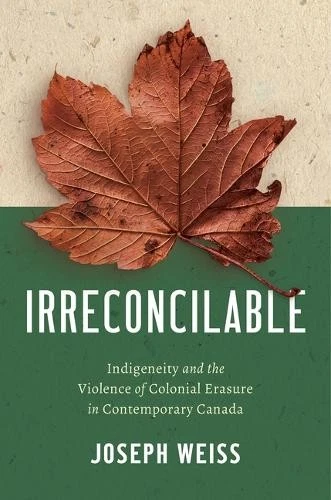
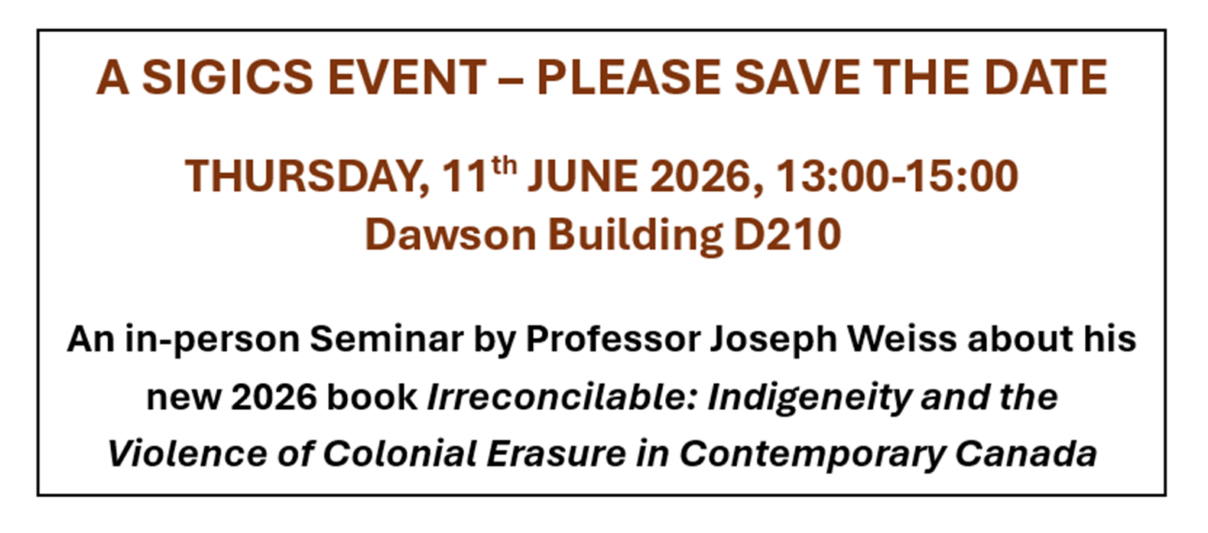
Since the early 2000s, the Canadian government has attempted reconciliation with Indigenous nations through varied efforts: In recent decades, the Canadian government has used different means to attempt reconciliation with its indigenous groups including treaty processes, government commissions, rebranding campaigns for settler-owned businesses, workshops for state and local officials, school curriculum changes, and a recently christened national holiday. The process is complicated and, as the author argues, serve to reinforce existing hierarchies. Joseph Weiss draws on a number of scholarly fields to unpack how attempts at reconciliation still lacks acceptance of responsibility for violence against indigenous groups and how these groups resist the erasure of past wrongs.
Joseph Weiss is an Associate Professor of Anthropology at Wesleyan University in Connecticut, USA. His work bridges sociocultural anthropology and Indigenous studies and explores connections between colonialism, ecology and Indigenous sovereignty. Professor Weiss works with the Haida Nation in Western Canada about whom he wrote his first book, Shaping the Future on Haida Gwaii: Life Beyond Settler Colonialism (University of British Columbia Press, 2018) investigating how the Haida in Western Canada use a variety of different strategies to deal with social and political changes to their way of life.
ABSTRACT
Irreconcilable: Indigeneity and the Violence of Colonial Erasure in Contemporary Canada
Reconciliation is everywhere in contemporary Canada. Since the early 2000s, in particular, the Canadian settler state has attempted reconciliation with Indigenous Nations through varied efforts: treaty processes, government commissions, rebranding campaigns for settler-owned businesses, workshops for state and local officials, school curriculum changes, and a recently christened national holiday. This talk, and the book from which it is drawn, contends that the goal of settler-driven reconciliation initiatives is, precisely, to make a better Canada. This, I argue, is a fundamental problem. Reconciliation, in these frameworks, works to erase Indigenous sovereignty, and, in particular, Indigenous claims to political autonomy and absolute (rather than subordinate) Title over their territories. The ubiquity of reconciliation conceals the violence of ongoing settler colonial domination, making it appear as if a reconciled Canada is a common-sense good and obvious shared goal for all who live within the country, regardless of whether or not they only do so because their extant sovereignty has been abrogated. Canada can only become “better” by effacing those elements of Indigenous political organization, law, and social and cultural life that cannot be reconciled with the colonial nation-state, and reconciliation makes it appear as if that disappearance is inevitable and appropriate. Yet as I also demonstrate, Indigenous Peoples have not accepted and do not accept the terms of this era of reconciliation. Indeed, their experiences reveal the violence that underlies the resolution that reconciliation seemingly promises.
My worktraces the relationship between the settler colonial erasure of reconciliation and the ways in which Indigenous Peoples refuse to be reconciled to their dispossession or even their outright elimination. Over and over again, I argue, the seductive promises of the era of reconciliation attempt to normalize, disavow, and erase the realities of settler colonial domination; over and over again, I also show, Indigenous Peoples refuse to allow these deceptions to stand unchallenged. Furthermore, Indigenous Nations are not passively responding to settler colonial strategies of erasure. Rather, it is settler society that is desperately responding to the unextinguished and ongoing realities and practices of Indigenous sovereignty, community, and anticipatory world-making. Reconciliation, as I demonstrate, is not an already-given reality which Indigenous people must simply accept; rather, reconciliation is a claim, a demand, and a settler aspiration, one which is all the more fragile and precarious for all the ways in which it is presented as necessary and inevitable.

While the history of African slavery is well known, Linford Fisher’s book deals with the much less covered history of indigenous slavery whereby European colonists to the Americas enslaved upwards of 3-6 million indigenous people including about 600,000 or more in North America. This accompanied the theft of indigenous lands and destruction of once-thriving ways of life. Once slavery was outlawed in the USA in the mid-nineteenth century, indigenous children were forcibly sent to boarding schools or into domestic servitude in the colonists’ homes. These customs continued well into the twentieth century.
Linford Fisher is an Associate Professor of History at Brown University in Rhode Island, USA. He earned his PhD at Harvard University in 2008 and moved to Brown from there. His research and teaching cover the cultural and religious histories of colonial USA and the surrounding Atlantic areas including the topic of indigenous slavery. He has also founded a collaborative, community based, tribal project called Stolen Relations: Recovering Stories of Indigenous Enslavement in the Americas that is creating an open-platform database of indigenous slavery across the Americas. Professor Fisher has published other books: The Indian Great Awakening: Religion and the Shaping of Native Cultures in Early America, co-author of Decoding Roger Williams: The Lost Essay of Rhode Island’s Founding Father, and co-author of Reading Roger Williams: Rogue Puritans, Indigenous Nations, and the Founding of America–A Documentary History.
Past events
View our previous meetings and presentations below
16th June, 2025, An Online SIGICS Event featuring a Talk by Jen Shannon

An online talk by Jen Shannon, Manager of Outreach and Engagement Planning at the National Museum of the American Indian (NMAI), part of the Smithsonian Institute in Washington DC, and Associate Professor and Curator of Cultural Anthropology at the University of Colorado, Boulder.
Dr Shannon talked about the history of the NMAI which is one of the newest Museums on the Mall in DC, its relationship with indigenous groups and its outreach programme. She also fielded questions from SIGICS members.
Jen Shannon is head of the Outreach & Engagement Planning Office at the National Museum of the American Indian, which works to develop and support collaborations and partnerships with indigenous tribal nations and related organizations. Dr Shannon is also an Associate Professor at the Department of Anthropology, University of Colorado, Boulder. Here she conducted fieldwork and taught in the Museum and Field Studies programme. Her focus is on collaborative public anthropology and ethical museum practises.
Wednesday 5th November, 2025 – The Layton Dialogue: Department of Anthropology and SIGICS, Indigenous Knowledge and Climate Change: Interdisciplinary Perspectives
A dialogue on different conceptions of human relations with the environment and nature posed by the apparent dichotomy between Indigenous and Western viewpoints.
Indigenous forms of knowledge and engagement with the environment have become a hot topic in international scientific and activist circles that are increasingly grappling with the threats posed by climate change. It is argued that Indigenous philosophies foreground ancestral links to the land, a sense of belonging, responsibility for sustaining environments, rootedness, kinship and reciprocity. In contrast, Western views separate and objectify nature and have been influenced by religious traditions supposedly giving humans “dominion” over the land. Consequently, humanity’s place is often conceived as a dominant force, an idea underpinning colonial usurpation of Indigenous lands around the world under the banner of “progress”. The 2025 Layton Dialogue will examine and problematise these dichotomies focusing particularly on indigenous use of fire, acknowledging that different forms of environmental relationships are key to achieving sustainable and equitable solutions to current climate crises and sustainable land use.
Wednesday 5th November, 2025 – The Layton Dialogue: Department of Anthropology and SIGICS, Indigenous Knowledge and Climate Change: Interdisciplinary Perspectives
Indigenous forms of knowledge and engagement with the environment have become a hot topic in international scientific and activist circles that are increasingly grappling with the threats posed by climate change. It is argued that Indigenous philosophies foreground ancestral links to the land, a sense of belonging, responsibility for sustaining environments, rootedness, kinship and reciprocity. In contrast, Western views separate and objectify nature and have been influenced by religious traditions supposedly giving humans “dominion” over the land. Consequently, humanity’s place is often conceived as a dominant force, an idea underpinning colonial usurpation of Indigenous lands around the world under the banner of “progress”. The 2025 Layton Dialogue will examine and problematise these dichotomies focusing particularly on indigenous use of fire, acknowledging that different forms of environmental relationships are key to achieving sustainable and equitable solutions to current climate crises and sustainable land use.
Speakers:
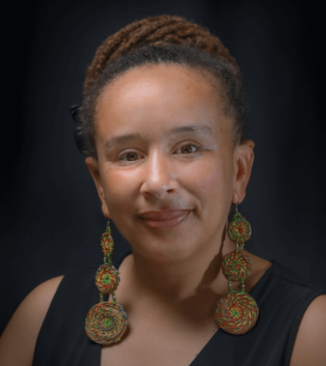
Prof. Middleton Manning is Designated Emphasis Chair in the Department of Native American Studies at the University of California Davis. She will be an IAS Fellow in Michaelmas 2025. Her research focuses on Native environmental policy and activism, with particular interest in environmental and climate justice, fire control, Indian land rights and intergenerational trauma.
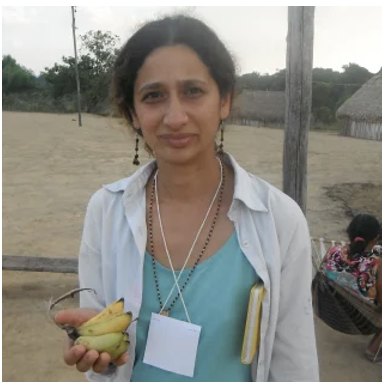
Prof. Jay Mistry is Professor of Environmental Geography and Associate Director of the Leverhulme Centre for Wildfires at Royal Holloway. Her research explores the integration of Indigenous knowledge in environmental governance with a particular interest in fire management and land protection in South America.
Discussants:
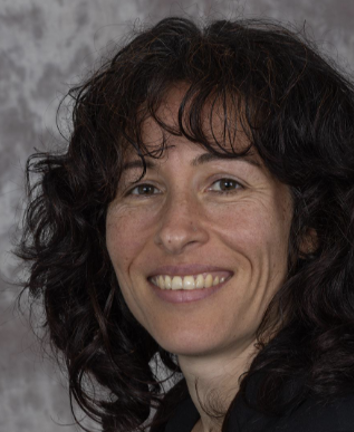
Dr. Penelope Anthias (Geography, Durham). Dr. Anthias studies the intersections between indigeneity, territory and the politics of resource extraction in Latin America. Her work engages with Indigenous and other racialized rural peoples not only as resources of empirical knowledge but as producers of ‘geographical theory’.

Dr Andrew Clelland is a postdoctoral researcher in machine learning and AI for wildfire modelling at the Data Science Institute of Imperial College London. After completing a PhD at the British Antarctic Survey in Cambridge and Durham, Andrew now works creating a AI model to forecast fire spread in 3D, with the intention of informing regional authorities and local communities of potential threats from approaching wildfires.
Thursday, 6th November, 2025 – SIGICS Sponsored Workshop on Indigenous Knowledge and Climate Change
The programme included the following:
10:00-10:20 – Round of introductions from all participants and scope of the workshop
10:20-10:45 – Danielle Johnson: Reflections on Indigenous Knowledge and Climate Change in Aotearoa New Zealand
10:45-11:10 – Andrew Clelland: Using machine learning and AI to forecast areas of risk under climate change
11:10 – 11:305 – Istvan Praet: Fire knowledges in Europe: how data science informs local practices
11:35 – 12:00 – Daniel Villar: Ethnobiology and Conservation in the Andes
12:00 – 13:00 – General discussion/lunch
Speakers:

Dr Danielle Johnson is a postdoctoral researcher in the Institute of Hazard, Risk & Resilience at Durham University. She uses participatory research to examine social aspects of climate change, and the vulnerabilities and adaptations people show in response. Danielle previously worked at the Aotearoa New Zealand National Institute for Water and Atmospheric Research where she worked on research projects in collaboration with local government authorities, Māori iwi (tribal organisations), and the private sector.

Dr Istvan Praet is an Assistant Professor in the Department of Anthropology, Durham University. He studies indigenous and scientific forms of knowledge and has undertaken research with the Chachi of Ecuador studying their ways of thinking about life, death, catastrophes and their practises of shape-shifting. More recently, he has been examining knowledge of wildfires in Europe among firefighters and foresters in parts of Europe.
Dr Andrew Clelland is a postdoctoral researcher in machine learning and AI for wildfire modelling at the Data Science Institute of Imperial College London. After completing a PhD at the British Antarctic Survey in Cambridge and Durham, Andrew now works creating a AI model to forecast fire spread in 3D, with the intention of informing regional authorities and local communities of potential threats from approaching wildfires.
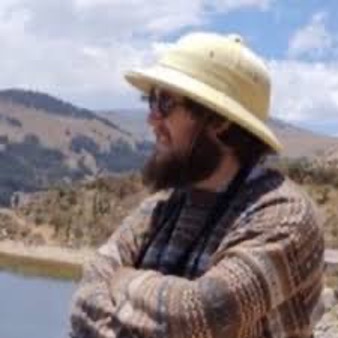
Dr Daniel Villar is a postdoctoral researcher in the Department of Anthropology, Durham University. He is an ecologist and conservation biologist studying ecological interactions between animals, humans and the landscapes they inhabit. His current project at Durham University is examining how traditional ecological knowledge is changing alongside climate and how these changes are affecting biocultural practises among indigenous peoples.
11th December, 2025 – A conversation with David Stirrup (University of York/Centre for Indigenous and Settler Colonial Studies) and Beth Rose Middleton Manning (California Davis/Department of Native American Studies/Durham IAS Fellow).

In the seminar Beth Rose and David talked about their experiences of teaching and researching in their respective institutions. What are the challenges facing Native and Indigenous studies programmes and cross-institutional centres? What are their strengths and the opportunities? How do Indigenous and Native colleagues and communities participate to research and teaching activities? How do such collaborations shape the direction of the Centre/Department?
David Stirrup is Professor of American Literature and Indigenous Studies in the Department of English and Related Literature at the University of York. David started the Centre for Indigenous and Settler Colonial Studies at the University of Kent in 2019 which then moved with him to York in 2023. The Centre sponsors a number of international research projects.
Monday 16th March, 2026 – Online Talk with Amanda Villa (Universidade de São Paulo): Distance, Communication, and Self-Determination among Isolated Indigenous Peoples in the Brazilian Amazon

The online presentation examined the context of Indigenous peoples living in isolation in the state of Rondônia, Brazilian Amazon, through an anthropological approach that engaged with the limits and possibilities of ethnography without direct contact. The analysis drew on archival records, institutional documents, and the knowledge of neighboring Indigenous communities, alongside the work of Brazil’s Indigenous protection agencies. Focusing on the Indigenous Lands of Uru Eu Wau Wau, Massaco, and Tanaru, the discussion situated isolation within longer histories of violence, territorial dispossession, and genocide processes. Particular attention was given to regimes of indirect communication – material traces, objects, environmental signs, and interspecies mediations – understood as semiotic and relational practices. Rather than conceptualizing isolation as absence or withdrawal, it was approached as a historically constituted mode of relationality through which autonomy, difference, and self-determination are continuously negotiated.
Amanda Villa is a researcher at the Amerindian Studies Center (CEstA-USP) and a member of the Observatory for the Human Rights of Isolated and Recently Contacted Indigenous Peoples (OPI). Conducts research in the field of Indigenous ethnology in the Médio Guaporé region (Rondônia, Brazil).